Research
Navigation: Home | Lab Members | Research | Teaching | Blog | Join the Lab
Research Questions
The Rosario Lab utilizes computational biomechanics to explore the fundamental principles of elastic mechanisms in biological systems. Our research seeks to bridge the gap between molecular-level elasticity and macroscopic organismal function to uncover the mechanics of biological movement. Three main pillars guide research in the Rosario Lab:
- Muscle-Tendon Dynamics: How do the dynamic interactions between active muscle and passive tendon modulate energy absorption and release during locomotion?
- Scale-Bridging Elasticity: How do molecular-level structural changes translate to the macroscopic elastic properties of biological tissues?
- Viscoelastic Function: To what extent does strain rate influence the functional limits and mechanical behavior of biological springs in various physical scenarios?
Recent projects
2025-12-03
#research
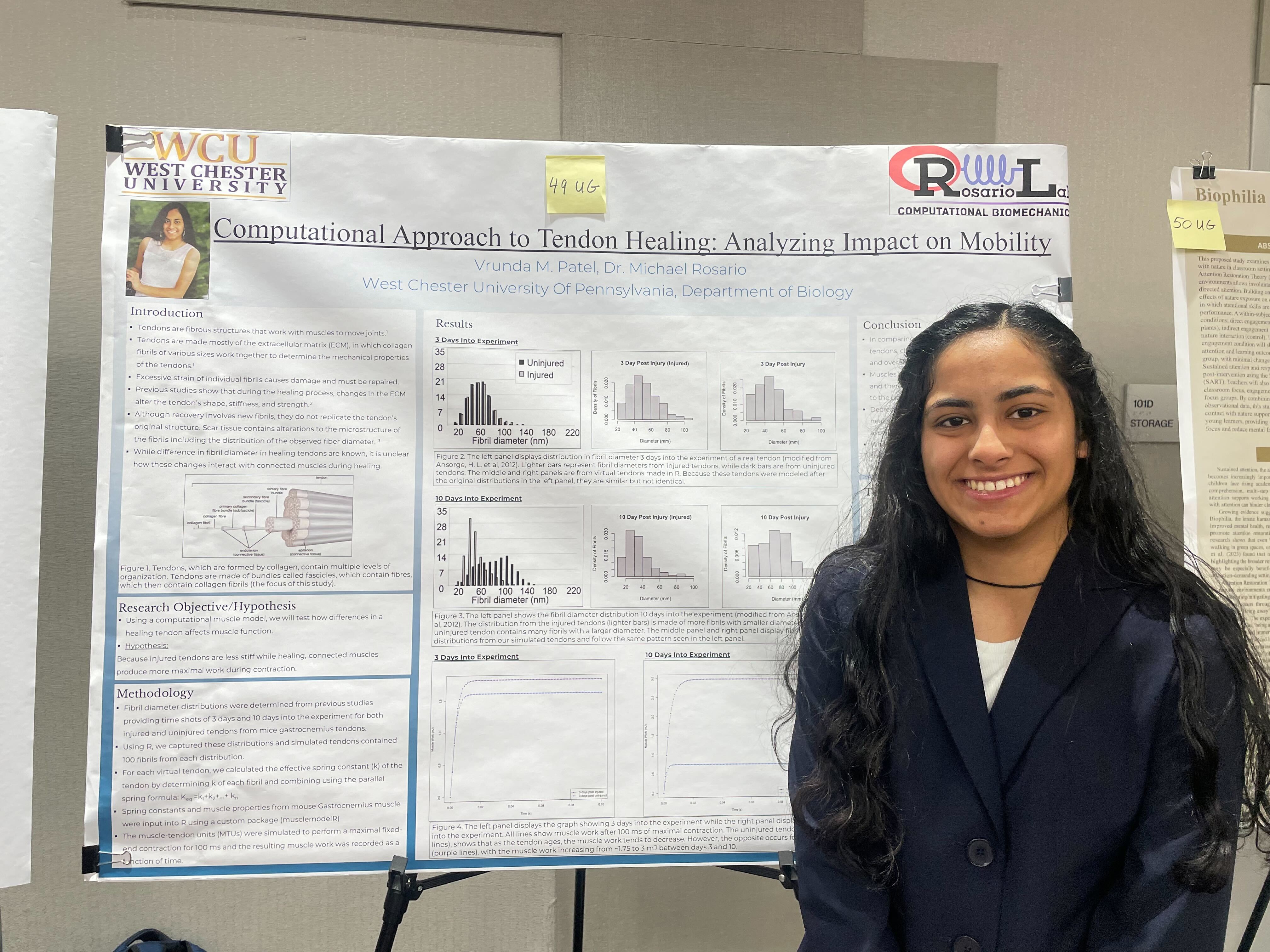
Vrunda Patel presented her research poster, Computational Approach to Tendon Healing: Analyzing Impact on Mobility, at the Fall 2025 CSM Celebrates Student Research Poster Session. Her work uses a computational muscle-tendon model of the gastrocnemius and Achilles tendon to investigate how structural changes during tendon healing — including alterations to the extracellular matrix and fiber diameter distribution — affect overall tendon and muscle function. Comparing simulations of injured and uninjured Achilles tendons, Patel found that muscles connected to injured tendons must shorten more, produce more work, and experience higher power output, offering new insight into how the healing process influences mobility and musculoskeletal recovery.
2025-07-09
#research
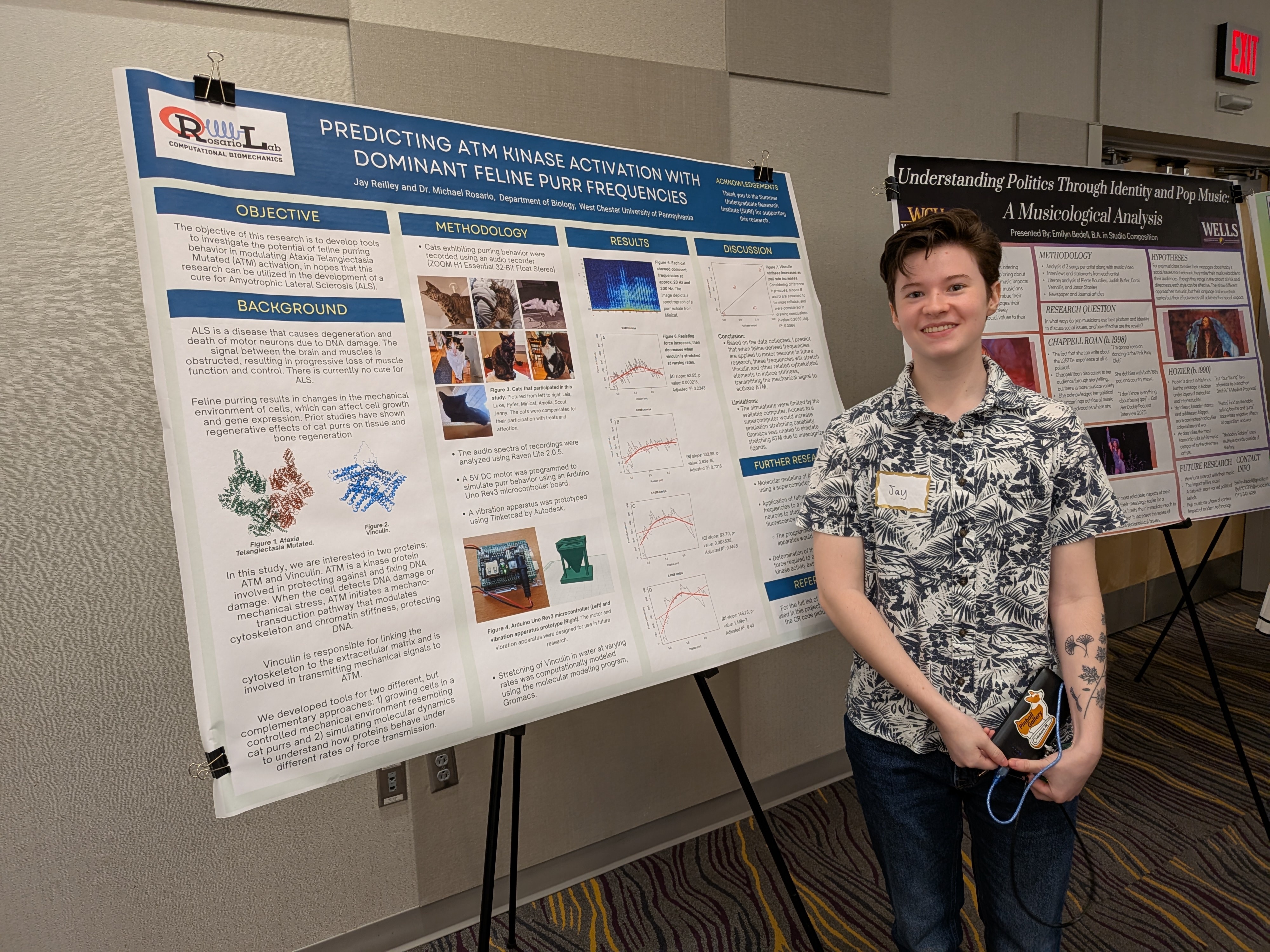
Jay Reilley presented his research poster, Predicting ATM Kinase Activation with Dominant Feline Purr Frequencies, at the Fall 2025 CSM Celebrates Student Research Poster Session. Reilley investigated whether the characteristic frequencies of domestic cat purrs — identified through spectral analysis of recordings from seven cats as clustering near 20 Hz and 200 Hz — could activate cellular DNA repair mechanisms. Using a custom motor-driven apparatus to transmit purr-like vibrations to cell cultures and computational modeling of the mechanosensitive protein Vinculin, the research found that simulated purr frequencies induce increased stiffness in cytoskeletal components, suggesting a potential pathway for activating ATM kinase, a key protein in DNA protection and repair.